
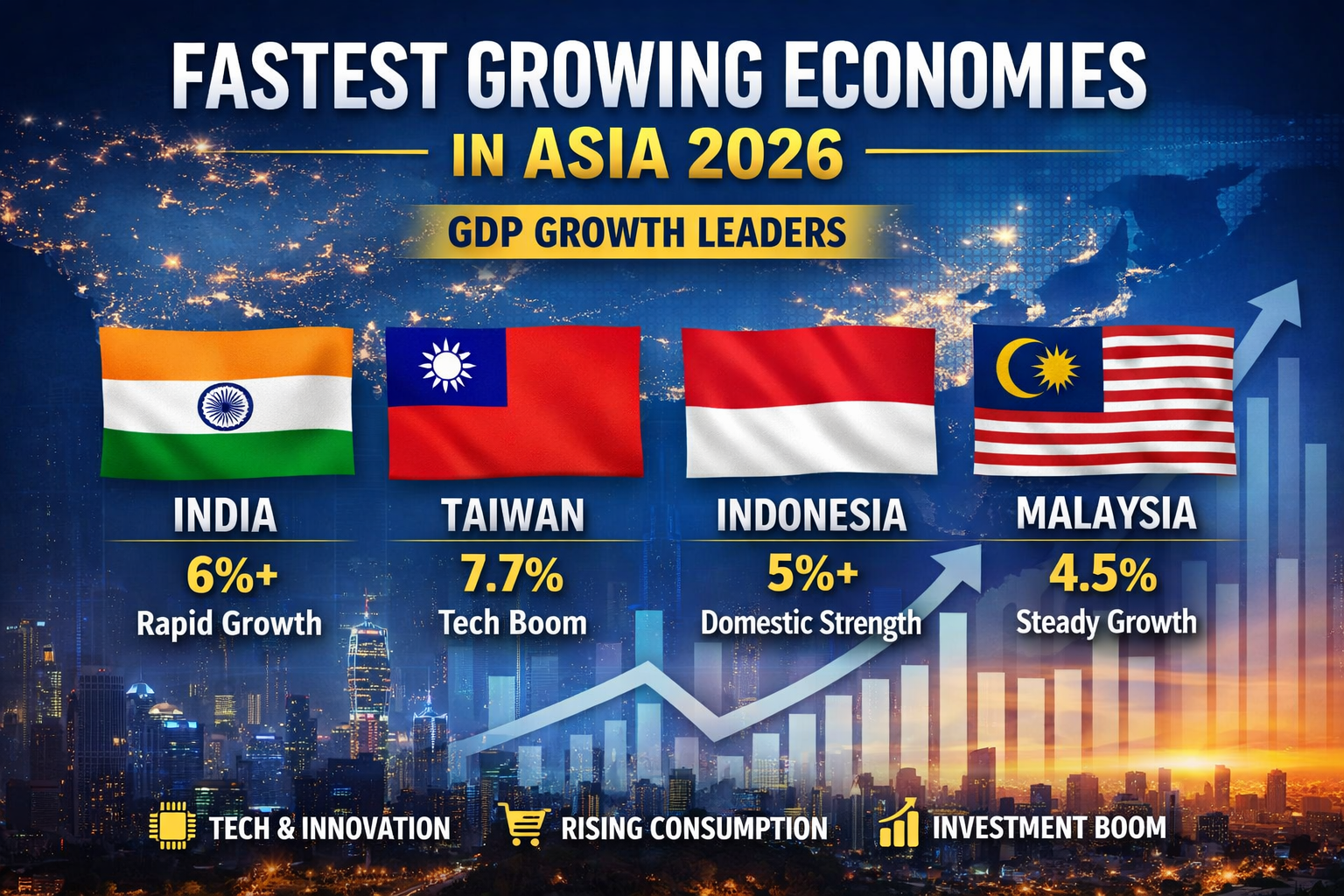
As the global economy navigates geopolitical tensions, shifting supply chains, and rising technological demand, Asia continues to emerge as a powerful growth engine. In 2026, several Asian economies are projected to outpace their peers, driven by domestic demand, innovation, demographic advantages, and structural reforms.
Economic forecasts from leading institutions highlight a dynamic landscape — with Asia playing a central role in global expansion.
India is projected to lead Asia’s growth in 2026 among major economies, with GDP expansion expected at around 6%+. This strong performance is supported by robust domestic demand, infrastructure investment, and a powerful services sector.
Key drivers include:
A thriving services industry and rising consumer spending
Continued policy reforms
Expanding manufacturing capabilities
Rapid digital adoption
With sustained reform and technology investment, India is not just growing fast — it is reshaping its position in the global economy.
Taiwan is expected to record one of the highest growth rates in the region, powered largely by global demand for semiconductors and artificial intelligence technologies.
Its export-oriented economy, deep integration into global chip supply chains, and leadership in advanced manufacturing keep it resilient even during wider global uncertainty.
Indonesia continues to post solid numbers, with growth staying above 5%. A large consumer base, steady industrial activity, and government spending on development projects support this expansion.
While not the absolute fastest in Asia, Indonesia stands out for its stability and ability to maintain momentum despite global pressures.
Malaysia’s outlook remains positive, with growth projected at around the mid-4% range. Domestic spending, recovering exports, and investment flows are strengthening the country’s economic foundation.
Its diversified economy and regional trade links help it remain competitive.
China remains a vital contributor to regional and global output due to its enormous industrial base, manufacturing ecosystem, and evolving consumer markets.
Vietnam is gaining attention for rapid industrial growth, foreign investment inflows, and strong export performance, making it one of Asia’s most promising emerging success stories.
Other nations across South Asia and Southeast Asia continue to benefit from young populations, urbanization, and supply-chain diversification.
Asia’s momentum in 2026 signals:
A continuing shift of global growth toward the East
Rising importance of technology and innovation
Stronger domestic consumption patterns
Expanding opportunities for trade and investment
At a time when several advanced economies are experiencing slower growth, Asia offers energy, scale, and long-term potential.
The story of Asia in 2026 is about resilience, modernization, and leadership. Economies such as India, Taiwan, Indonesia, and Malaysia are setting the pace and shaping the future of global development.
They are not simply growing faster — they are becoming the drivers of tomorrow’s economic order.

Welcome to Business Success Elites, one of the fastest-growing magazines in India. As the leading authority in business content, we are dedicated to delivering thought-provoking, high-quality material that shapes the future of industries worldwide. We are a means for entrepreneurs and business leaders to get notoriety within our reader base.